Slab leaks in Homestead slab-on-grade homes
Slab leaks are the leak type Homestead homes are most prone to, because most of the housing stock is built slab-on-grade with pipes running through or under the concrete. This guide from MW Plumbing explains the signs, how a leak is located without tearing up the floor, and the repair options.
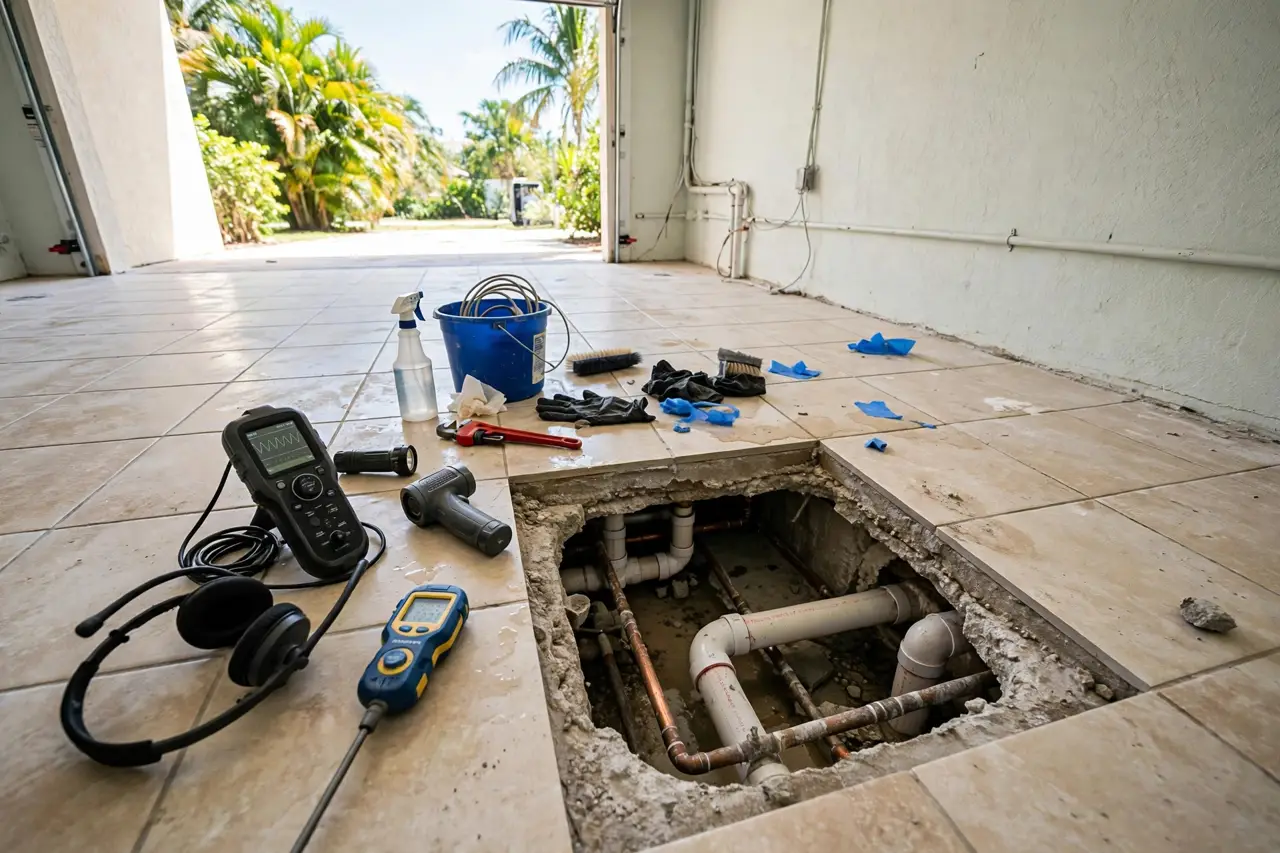
Slab leaks are the leak type Homestead homes are most prone to, because most of the housing stock is built slab-on-grade with pipes running through or under the concrete. This guide from MW Plumbing explains the signs, how a leak is located without tearing up the floor, and the repair options.
What a slab leak actually is
A slab leak is a leak in a water line that runs through or under the concrete slab of a slab-on-grade home. Most Homestead homes are built this way: a concrete slab poured over compacted fill, with supply lines and sometimes drain lines embedded in or beneath it, because the high water table and porous limestone ground leave no practical room for a crawlspace or a lower level.
That construction is why slab leaks behave differently from other leaks. The water has nowhere visible to go. It wicks into soil and concrete, spreads under flooring, and shows up as a warm spot, a damp baseboard, or a climbing water bill long before it shows up as a puddle. By the time flooring buckles, the leak has usually been running for weeks.
For the wider hidden-leak picture, see our leak detection guide, and for the service itself, our leak detection in Homestead page.
Signs of a slab leak in a Homestead home
- A warm spot on the floor. The classic hot-line sign: a patch of floor that is noticeably warmer than the surrounding slab, often in a kitchen or bathroom.
- A water bill that climbs for two months. Compare gallons used, not just the amount due. A steady climb with no change in habits points at a pressurised leak.
- Running water sound with nothing on. Stand quietly at night: a hiss or flow sound with every fixture off is a pressurised line leaking.
- Damp baseboards or flooring changes. Cupping, buckling, or dampness along a wall line can be slab moisture reaching the finish.
- Cracks near a line run. Soil washed out by a long-running leak can let a slab section settle and crack, though cracks alone have many causes and need checking, not assuming.
How to find a slab leak in your Homestead home
Finding a slab leak starts with confirming that a leak exists, then narrowing it before any concrete is touched. Do the meter checks first, and leave the locating equipment to the professional visit.
Step 1: The meter test
Shut every fixture and irrigation zone, then watch the meter's low-flow indicator for 30 minutes. Movement with everything off confirms a pressurised leak somewhere in the system.
Step 2: The warm-spot and sound check
Walk the home barefoot, feeling for warm patches, and listen at night for running water with nothing on. Note exactly where each sign is: that map is the first thing a locator asks for, and it narrows the search area considerably.
Step 3: The isolation test
Close fixture valves one area at a time and re-check the meter. When the meter stops, the leak is in the area you just isolated. If it never stops with fixtures closed, the leak is in a main run or under the slab, and acoustic detection is the next step.
Slab leak detection: why South Florida homes are prone
Slab leak detection in Homestead is a bigger deal than in most of the country because slab-on-grade is the standard here, not the exception. Pipes embedded in concrete cannot be inspected visually, cannot be reached without opening the slab, and sit in soil that shifts with the wet and dry seasons. Hard water from the Biscayne Aquifer adds wear from the inside, and older builder runs of thin-wall copper through the slab, with no sleeve, fail sooner than protected runs.
Detection therefore relies on equipment, not eyesight: acoustic listening picks up the leak's sound through the slab, thermal imaging shows the heat pattern of a hot-line leak, and a pressure test on the isolated line confirms the location before any repair is quoted. A location confirmed three ways is a repair; a location guessed once is a hole in the wrong place.
If the problem turns out to be on the drain side rather than a supply line, our sewer line cleaning in Homestead team handles it with a camera, since drain leaks need a different toolset from supply leaks.
What affects slab leak repair cost in Homestead
What affects slab leak repair cost in Homestead is the repair path, and the path follows the pipe's history. A spot repair opens the slab at the confirmed point, replaces the failed section, and restores the concrete and flooring. An overhead reroute abandons the failed line entirely and runs new pipe through walls or the attic, avoiding concrete work and removing that line from the slab for good.
The reroute suits a system that has already failed more than once, or a run whose material and age suggest further failures. The spot repair suits a single failure in an otherwise sound system. MW Plumbing quotes before work starts, after the leak is located and confirmed, and quotes both paths where both are genuinely available, so the choice is made on evidence, not on a single option presented as the only one.
Common mistakes homeowners make
- Waiting for a puddle. Slab leaks rarely puddle. Waiting for one means waiting months while water works on soil and flooring.
- Opening concrete before locating. An unconfirmed location turns one hole into several, and several holes into a flooring project.
- Trusting a single test. Meter, acoustic, thermal and pressure together confirm a point. Any one alone can mislead.
- Repairing without checking the rest of the run. A corroded run that has failed once will often fail again nearby; ask what the neighbouring sections look like.
- Patching flooring before fixing the pipe. New flooring over an active leak is a second flooring job waiting to happen.
When to call a professional
Call MW Plumbing at (786) 523-6480 if the meter moves with fixtures off, if you feel a warm spot on the slab, if you hear running water with nothing on, or if flooring or baseboards show dampness you cannot explain. Describe the signs and where they are; that map is the starting point for the locator.
For homes in Oasis and the surrounding northeast Homestead communities, see our plumber in Oasis page for local service details.
Frequently Asked Questions
What are the signs of a slab leak in a Homestead home?
A warm spot on the floor, a water bill that climbs with no change in use, the sound of running water when nothing is on, dampness along baseboards, and cracks or buckling in flooring near a slab line. Warm spots point at a hot water line; a climbing bill with no warm spot points at a cold line or a drain.
How is a slab leak found without tearing up the floor?
With the meter test first, then acoustic listening equipment and thermal imaging to narrow the location, and a pressure test on the isolated line to confirm it. The goal is a confirmed point, not a search pattern in concrete, so a plumber who wants to open the slab before locating should be asked how the location was confirmed.
What affects the cost of slab leak repair in Homestead?
Location and access drive the scope: a confirmed point under an accessible floor is a different job from a leak under tile or cabinetry, and a spot repair differs from an overhead reroute that abandons the failed line. MW Plumbing quotes before work starts, after the leak is located and confirmed.
Can a slab leak go undetected for months in Homestead?
Yes. A slab leak under a pressurised line runs continuously, but the water wicks into soil and concrete instead of pooling where you can see it. That is why the monthly meter check matters: it catches a leak that the floor hides.
Should I repair or reroute a slab leak in Homestead?
It depends on the pipe's age and history. A single leak in an otherwise sound system suits a spot repair. Repeated slab leaks, or a system of an age and material that keeps failing, suit an overhead reroute that takes the line out of the slab entirely. A plumber should quote both where both are genuinely available.
Get help with plumbing in Homestead
Test the meter, map the warm spots and sounds, and get the leak located and confirmed before any concrete is opened. A confirmed point is the difference between a repair and a demolition project.
Call MW Plumbing at (786) 523-6480 for slab leak detection in Homestead. We are open 24 hours, every day.
Common questions
A few answers before you start.
A warm spot on the floor, a water bill that climbs with no change in use, the sound of running water when nothing is on, dampness along baseboards, and cracks or buckling in flooring near a slab line. Warm spots point at a hot water line; a climbing bill with no warm spot points at a cold line or a drain.
With the meter test first, then acoustic listening equipment and thermal imaging to narrow the location, and a pressure test on the isolated line to confirm it. The goal is a confirmed point, not a search pattern in concrete, so a plumber who wants to open the slab before locating should be asked how the location was confirmed.
Location and access drive the scope: a confirmed point under an accessible floor is a different job from a leak under tile or cabinetry, and a spot repair differs from an overhead reroute that abandons the failed line. MW Plumbing quotes before work starts, after the leak is located and confirmed.
Yes. A slab leak under a pressurised line runs continuously, but the water wicks into soil and concrete instead of pooling where you can see it. That is why the monthly meter check matters: it catches a leak that the floor hides.
It depends on the pipe's age and history. A single leak in an otherwise sound system suits a spot repair. Repeated slab leaks, or a system of an age and material that keeps failing, suit an overhead reroute that takes the line out of the slab entirely. A plumber should quote both where both are genuinely available.
Need a local hand?
Need slab leak detection in Homestead? Call MW Plumbing.
MW Plumbing locates slab leaks with acoustic and thermal equipment, confirms them with a pressure test, and quotes before work starts. Open 24 hours, every day. Call (786) 523-6480.